
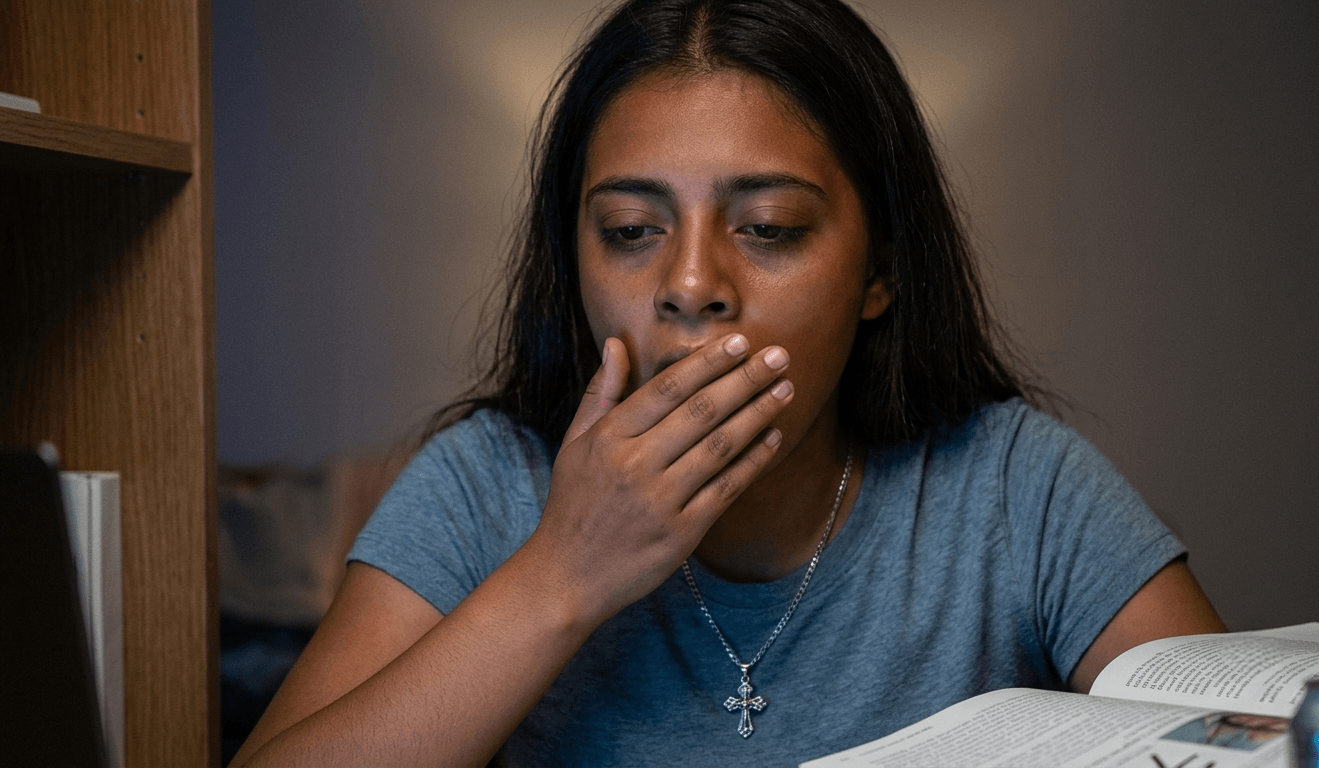
Your teenager drags themselves out of bed like it is physically painful. They are wrecked by mid-afternoon, wired again at midnight, and impossible to wake on school mornings. On weekends they sleep until noon and still seem exhausted. If this sounds familiar, your teen is almost certainly part of a quiet epidemic that affects the majority of American teenagers, and it is doing far more damage than most parents realize.
Teenage sleep deprivation is one of the most common and most overlooked health problems of adolescence. It is easy to dismiss as teens just being lazy or dramatic. In reality, chronic lack of sleep affects their mood, their grades, their health, and their mental wellbeing, and much of it is driven by two things working together: biology and screens. Here is what is going on and how to help your teen get the rest their growing brain desperately needs.
The scale of this problem is genuinely striking. The Centers for Disease Control and Prevention has found that roughly three out of four US high school students do not get enough sleep on school nights. The American Academy of Sleep Medicine and the American Academy of Pediatrics recommend that teenagers get eight to ten hours of sleep per night. Most are getting well under that, many running on six or seven hours during the school week.
This is not a small shortfall. A teen getting six hours a night when they need nine is carrying a sleep debt equivalent to pulling a partial all-nighter every single night. No adult would expect to function well on that, yet we expect teenagers to learn calculus, manage their emotions, play sports, and navigate complex social lives while chronically exhausted.
The consequences pile up fast. Sleep-deprived teens struggle to concentrate and remember what they learn, which hits their grades. They are moodier, more irritable, and more emotionally reactive, because sleep is when the brain resets its emotional thermostat. The CDC has also linked insufficient sleep in teens to higher rates of risky behavior and poorer mental health. Sleep is not a luxury that competes with everything else your teen needs. It is the foundation everything else sits on.
Here is something that surprises a lot of parents. Your teenager is not staying up late purely out of stubbornness. During adolescence, the body’s internal clock shifts. The brain starts releasing melatonin, the hormone that makes us sleepy, later at night than it did in childhood and later than it will in adulthood.
This shift, sometimes called sleep phase delay, means a teenager genuinely does not feel tired at 9 or 10 pm the way a younger child does. Their biology is pushing them toward a later sleep and a later wake. The problem is that school start times did not get the memo. Most high schools begin early, forcing teens awake in the middle of what their body considers the night. The result is a daily collision between teenage biology and the school schedule, and the teen loses every time.
Understanding this matters because it changes the frame. Part of your teen’s sleep struggle is not a discipline failure you can lecture away. It is a real biological drift. That does not mean you throw up your hands. It means you work with the biology instead of against it, and you remove the things making it worse. Which brings us to the screens.
If biology nudges teens toward later sleep, screens shove them off the cliff. There are three ways phones and devices sabotage teenage sleep, and together they are brutal.
First, screens displace sleep directly. A teen who is scrolling, gaming, or chatting at midnight is simply not sleeping during that time. With nearly half of teens reporting they are online almost constantly, according to Pew Research Center, the late-night hours have become prime screen time. Every video leads to another, every chat invites a reply, and the clock keeps moving.
Second, the content keeps the brain switched on. Social media, games, and group chats are stimulating and emotionally activating by design. They trigger alertness, excitement, and sometimes stress right when the brain should be winding down. A teen who gets into an argument in a group chat at 11 pm is not going to drift peacefully off to sleep.
Third, the light interferes with the sleep signal. Screens emit light that can suppress melatonin, the very hormone a teenager is already releasing too late. So the device is pushing back the sleep clock even further, on top of a biology that already delays it.
Put these together and you get the classic pattern. A tired teen lies in bed with their phone, meaning to sleep, and two hours vanish. The phone in the bedroom overnight is, for most teens, the single biggest obstacle to adequate sleep.
Some tiredness is normal in adolescence. Watch for the signs that sleep loss has become a genuine problem. These include needing extreme effort to wake on school days, falling asleep in class or in the car, a large gap between weekday and weekend sleep as they try to catch up, worsening mood and irritability, slipping grades, and relying on caffeine or energy drinks to get through the day. A big catch-up sleep on weekends is a clear tell that the weekday debt is high.
You cannot change your teen’s biology or their school start time, but you can remove the obstacles and build habits that work with their body rather than against it. These steps make a real difference.
Of all the battles parents pick in the teenage years, sleep is one of the most worthwhile, because it quietly improves almost everything else. A rested teen is in a better mood, copes with stress more easily, learns and remembers more, and is at lower risk for anxiety and depression. Fixing sleep will not solve every teenage problem, but neglecting it makes every other problem harder.
Your tired teenager is not just being dramatic, and they are not beyond help. They are caught between a biology that delays their sleep, a school system that ignores it, and devices engineered to keep them up. You cannot fix all of that, but you can change what happens in your own home. Start with the phone leaving the bedroom tonight, and build from there. Better sleep is one of the most powerful and underused tools you have for helping your teen thrive.