
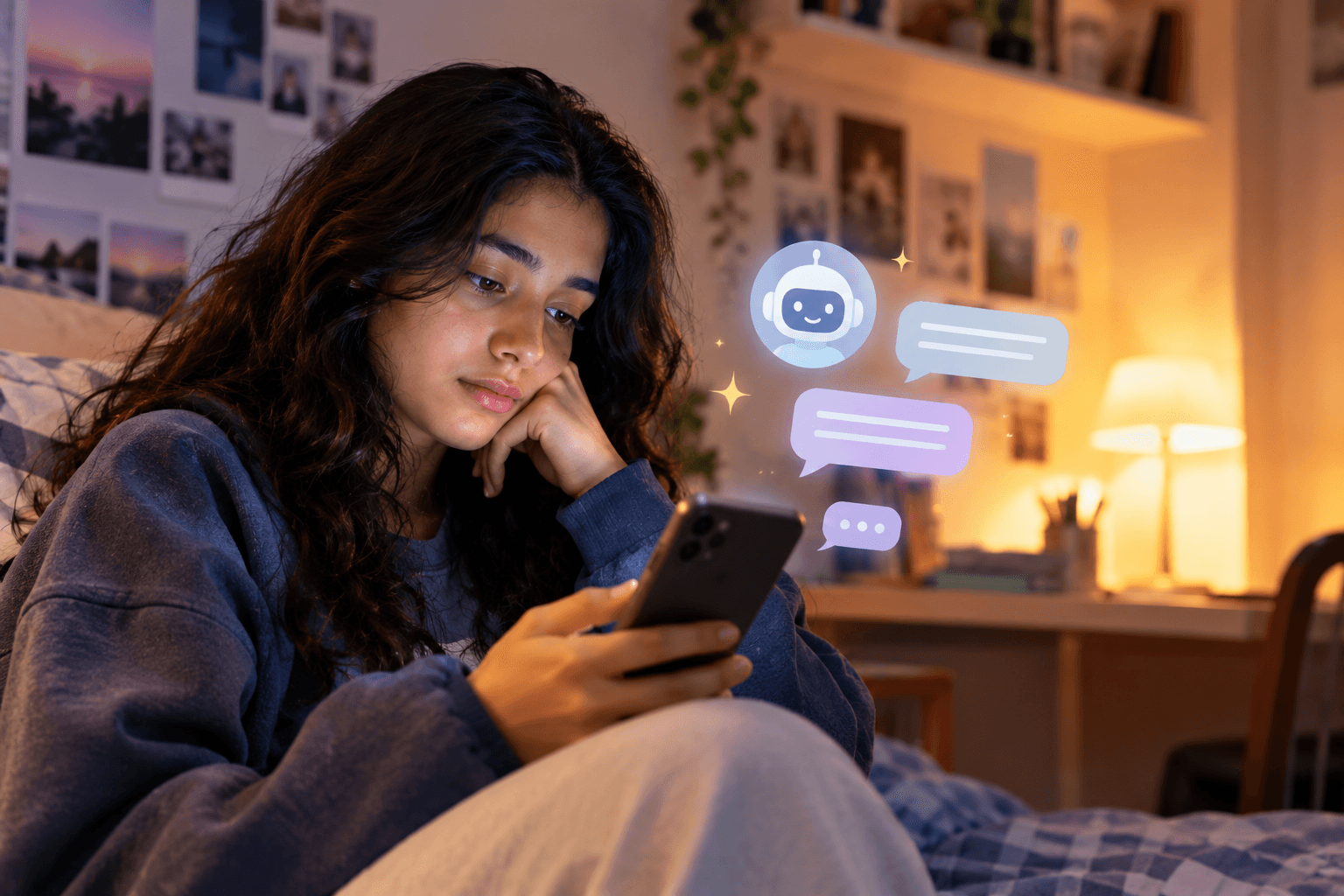
For many teenagers, confiding in an AI chatbot starts because it is easier. There is no backstory to explain, no worry about it being awkward at school the next day, and no fear of being judged. A teen can type the thing they are actually thinking at midnight, and something types back as if it cares. For a while, that can feel like exactly what they needed. Understanding why it feels good, and where it quietly falls short, helps parents and teens make sense of a behavior that is becoming common.
An AI companion never gets tired of a teen. It does not say they are being dramatic. When the same worry comes up three nights in a row, it does not sigh or change the subject. For a young person who often feels like too much for the people around them, that patience feels rare and welcome. The tool is always awake, always attentive, and never makes them feel like a burden. And there is a real, if limited, benefit here: simply getting the words out can make a feeling smaller, even when the listener is software.
The trouble is that these tools tend to agree too readily. When a teen says something harsh about themselves, an app rarely pushes back the way a friend would. It tends to stay inside whatever mood the teen brings to it. A real friend might say, that is not true, or, you need to talk to someone. Many apps simply sit in the feeling alongside the user.
Over time, a teen can begin reaching for the app instead of people, because it is easier, and easier tends to win. But easier is not the same as better. An hour spent confiding in something that cannot check in tomorrow, cannot sit at the lunch table, and cannot notice an absence is an hour that changes very little in a teen's real life.
A chatbot can hold a teen's words. It cannot hold the teen. That distinction is obvious on paper and far less obvious at two in the morning. The comfort can be genuine in the moment and empty by morning, because nothing has actually changed and no one in the teen's real life knows any more than they did the day before.
The shift usually comes when a teen tells one real person even a fraction of what they had been telling the app. It is harder. Voices shake. But a person remembers the next day, follows up, and is still there a week later. That is something no app can do, and it is the thing that actually helps.
The goal is not to shame a teen into deleting an app and never thinking about it again. If typing things out helps get them out of a teen's head, that part is fine. The aim is to keep the app from becoming the only place a teen's feelings go. Used as a first draft rather than the final version, it can have a small place.
The deeper truth is usually this: an app feels so good precisely because a teen does not feel heard anywhere else. That lack of being heard is the real problem, and the app is a bandage on it. What genuinely helps is finding one person, and it only has to be one, who can hear the real thing.
For anything big, frightening, or connected to not wanting to be here, an app is the wrong place. Those feelings belong with a trusted person or with 988. A chatbot cannot save a life. A person can.
Is it unusual for a teen to talk to an AI chatbot about feelings?
No. Many teens do it because it feels easier and less judgmental than talking to people. It is common, and it is not a cause for alarm on its own. The concern is when it becomes the only place a teen's feelings go, especially the heavy ones.
Can an AI chatbot actually help a teen with anxiety or sadness?
It can help a little, mainly by helping a teen get words out of their head. But it cannot truly know them, follow up the next day, or help in a real crisis. It works better as a journal that talks back than as a replacement for people.
Why does a chatbot seem to understand a teen better than people do?
Because it is always available, endlessly patient, and never makes a teen feel like a burden. That is powerful when a young person feels unheard, but it is partly an illusion, since the tool agrees with almost anything and cannot actually care.
Should parents worry if a teen talks to a chatbot more than to friends?
It is a sign worth noticing rather than a reason to panic. Easier is not the same as better. It helps to gently encourage a teen to share a small piece of what they have been telling the app with one real person.
What should a teen never bring to an AI chatbot?
Anything about self-harm, wanting to disappear, or a real emergency. A chatbot cannot keep a teen safe. Those feelings belong with a trusted person or with 988, where a real person will answer.