
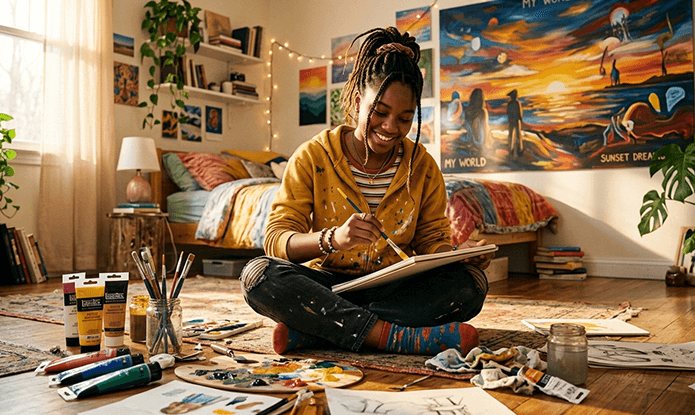
Creative expression goes way beyond the reach and influence of gallery-worthy paintings or published novels. It covers any activity that uses imagination and personal view to communicate ideas, feelings, or experiences. A teen sketches during class, writes song lyrics in their phone, films a short video, or arranges their room in a way that feels authentically theirs. They're engaging in creative expression.
The process matters more than the product. Adolescents don't need formal training or natural talent to benefit from creative activities. What counts is the act of transforming internal experiences into something external and tangible. That transformation happens whether someone is molding clay, strumming a guitar, or coding a simple game.
Creative expression takes countless forms in teenage life. Visual arts include drawing, painting, photography, and digital art. Musical expression ranges from playing instruments to creating music loops or writing songs. Physical creativity shows up through dance and movement-based activities.
Written forms include journaling, poetry, fiction writing, and screenwriting. Many teens express themselves through video creation, animation, fashion choices, or making collages. Digital creativity counts just as much. Editing videos, designing graphics, building worlds in games, or creating podcast content all qualify as meaningful creative expression.
The variety matters because different people connect with different mediums. Some teens process emotions through visual art while others need words or movement.
Creative activities affect adolescent mental health and wellbeing in substantial ways. Research shows that more than 60% of young people who participated in creative expression reported boosted confidence. Schools see measurable benefits too. For every year of arts participation, there was a 20% reduction in the likelihood that an adolescent would receive an out-of-school suspension.
The brain science explains why creativity helps. The brain undergoes substantial development in areas responsible for decision-making and emotional regulation during adolescence. Creative activities activate both emotional centers and executive functions at once. This helps teenagers process complex feelings and develop deeper self-understanding.
Creative expression also provides relief at the time verbal communication feels impossible. Frustrations find release through bold brushstrokes. Confusion transforms into poetry. Overwhelming emotions become manageable through the focused act of creating. Studies about arts-based interventions have pointed to specific benefits. These include stress and anxiety reduction, improved emotion regulation, and boosted social resilience.
Teenagers struggle to state complex emotions verbally, especially when you have an adolescent brain still developing in areas responsible for emotional regulation and communication. Art therapy provides an alternative pathway that doesn't require finding the right words. Research shows art therapy works for conditions like anxiety, depression, PTSD and trauma. Studies report 60-75% of participants experiencing reduced symptoms.
Results showed that 45 minutes of unstructured art-making encouraged natural dopamine release and regulated the amygdala-driven fight-or-flight response. Art therapy outperformed weekly talk therapy sessions when done twice-weekly in direct comparisons. Imagery taps into a person's earliest way of knowing and reacting to the world. This makes it available even when verbal capacities fail.
Art therapy strengthens self-awareness and control because teenagers choose what to draw, what to share and how to participate. That sense of agency proves healing in itself. The finished piece represents an accomplishment independent of their struggles when teens create art. The process externalizes negative behaviors and makes the behavior the problem rather than the individual. This separation allows adolescents to address difficulties without internalizing failure or shame.
Art therapy for trauma gives teenagers something they need: a way to express what they don't yet have words for. Creating art bypasses verbal defenses that block traditional therapy. The message is "don't tell" in families with secrets, especially those involving abuse, but no one forbids drawing. Art becomes a protected space where adolescents develop a sense of safety while expressing inner feelings and facilitating emotional competence.
Open your phone's notes app or grab any paper. Set a 10-minute timer. Draw, paint, doodle or collage whatever you're feeling right now—not what it looks like, but what it feels like. Notice how you feel compared to when you started when the timer ends. Other activities that work include creating emotion color wheels to map mood shifts, drawing a safe place for grounding during stress or making self-portraits that externalize identity questions.
Storytelling allows teenagers to reauthor their experiences and transform from victims of anxiety into authors of their own narratives. Narrative therapy helps teens separate themselves from their problems and view anxiety or trauma as just one chapter rather than their whole identity. Writing externalizes thoughts and emotions and makes them concrete rather than abstract swirling anxieties. Research shows that expressive writing reduces symptoms of depression, anxiety and PTSD while improving self-esteem and resilience.
Journaling reduces activity in the amygdala, the brain's alarm system, while engaging the prefrontal cortex responsible for reasoning and emotional regulation. This dual action helps teens bridge the gap between raw emotion and thoughtful reflection. Studies found that journaling can be as effective as cognitive behavioral therapy in managing depression symptoms. Write for 15 minutes about something sitting heavy on your mind. Don't edit. Don't reread. Research by psychologist James Pennebaker found that this practice, done for 4-5 days, reduces stress symptoms and improves immune response.
Start with these: What's one thing you did today that took courage? What wound are you protecting by keeping people at a distance? If your feelings could speak, what might they say? Write a letter to your future self five years from now.
Keep a journal available wherever inspiration strikes. Start small with just a few sentences rather than full pages. Write in a quiet, comfortable space without judgment about spelling or grammar. Sometimes it helps to know someone else will see your work. Submit your photo, poem, art or story to the Expression Arena and let the world hear your voice.
Parents stand at a crossroads between nurturing creativity and crushing it without meaning to. Only when we are willing to recognize behavioral shifts that signal emotional distress can we understand when teenagers just need creative outlets.
Persistent mood swings, angry outbursts over minor issues, or withdrawing to their room for long stretches often indicate deeper struggles. Constant boredom, disinterest in once enjoyed activities, or constant irritability suggest your teen just needs alternative ways to process emotions. These signs point toward a need for creative expression rather than more structured obligations.
Resources without expectation work best. Leave art supplies visible, share writing prompts at dinner, or play music without demanding performance. Your job centers on creating access rather than pressure. Model creative involvement by pursuing your own interests and show that creativity belongs in adult life as much as in teenage years.
Safety matters more than lectures. Present options using phrases like "Would you be up for..." rather than "You should...". Choice gives teenagers power. Link suggestions to existing priorities rather than imposing your own.
Process matters more than product. The therapeutic value exists in creating, not in the finished piece. Offer suggestions rather than commands, acknowledge difficulty, and accommodate their pace. Praise effort and risk-taking whatever the outcomes.
Teens who create through journaling, doodling, or making videos engage in meaningful creative expression privately. Platforms like Expression Arena provide judgment-free spaces where teenagers submit photos, poems, art, and writing to connect with peers worldwide for those ready to share.
Creative expression gives teenagers a powerful tool to manage anxiety, process difficult emotions and build confidence. Of course, the process matters much more than the product. Teens can start tonight with simple 10-minute exercises, whether through journaling, drawing or any creative medium. Parents should provide resources without pressure and celebrate effort rather than outcomes. Platforms like Expression Arena provide judgment-free spaces where creative work connects with peers worldwide for those ready to share their voice. The therapeutic benefits begin the moment creativity starts.
Creative expression allows teens to explore and communicate complex thoughts and emotions they may not fully understand yet. Through activities like drawing, writing, or music, they can tap into their subconscious feelings and transform internal experiences into something tangible, helping them develop deeper self-understanding and process their identity questions
Teens can express themselves through visual arts (drawing, painting, photography, digital art), musical activities (playing instruments, writing songs, creating music loops), physical creativity (dance, movement), written forms (journaling, poetry, fiction), and digital media (video editing, graphic design, podcasting). The variety ensures every teen can find a medium that resonates with them.
Art therapy provides an alternative pathway for teens who struggle to articulate emotions verbally. Research shows 60-75% of participants experience reduced symptoms of anxiety, depression, and PTSD. Creating art bypasses verbal defenses, releases natural dopamine, and helps regulate the brain's stress response, making it particularly effective when done twice weekly.
Teens can begin with a 10-minute drawing or doodling session expressing current feelings, create emotion color wheels to map mood shifts, write journal entries for 15 minutes without editing, draw a safe place for stress relief, or make self-portraits exploring identity. These activities require no special training or materials to provide therapeutic benefits.
Parents should provide accessible resources like art supplies or writing prompts without demanding results, celebrate effort and process rather than finished products, use phrases like "Would you be up for..." instead of commands, and model creative engagement by pursuing their own interests. The key is creating access and safety rather than imposing expectations.