
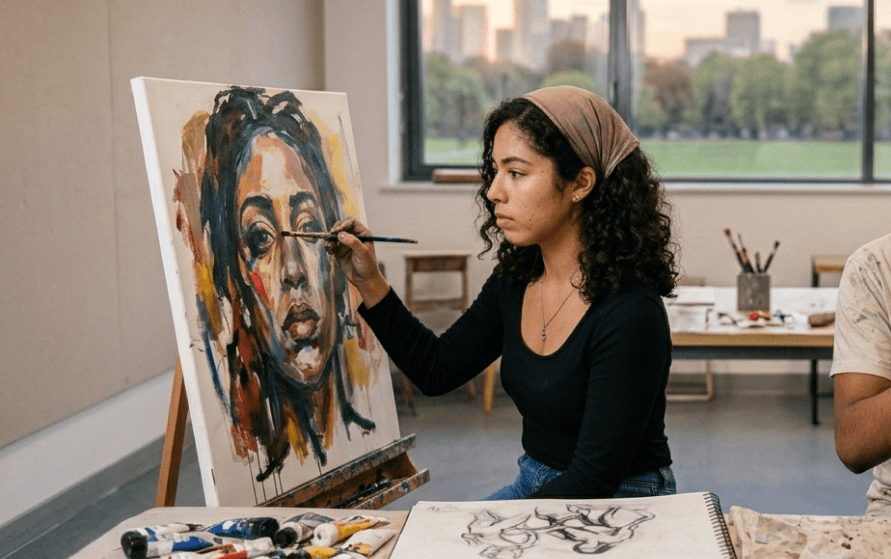
Self-expression is often treated as a pleasant but secondary activity, something young people do for enjoyment or relief rather than a process with measurable cognitive effects. A growing body of research across psychology, education, and neuroscience suggests this framing understates its importance. Expression and creativity appear to operate as a reinforcing loop: the act of expressing what is internal reduces emotional and cognitive load, which in turn frees the mental resources that creative thinking depends on, while creative practice expands the range of what a person is able to express. For adolescents, whose brains are undergoing significant development, this loop may be especially consequential.
This article reviews what the evidence indicates about that relationship. It is written for educators, researchers, and interested parents, and it treats self-expression not as decoration but as a cognitive and developmental mechanism worth understanding on its own terms.
Clarity matters here, because “expression” and “creativity” are often used loosely. In the research literature, self-expression refers to the externalization of internal states, thoughts, feelings, perceptions, or experiences, into some communicable form: words, images, movement, sound. It does not require originality. A person expressing grief in a journal is engaged in expression regardless of whether the writing is novel.
Creativity, by contrast, is generally defined by two criteria: novelty and usefulness or appropriateness. Creative output is both new and fitting for its context. The cognitive engine most associated with it is divergent thinking, the capacity to generate many varied ideas from a single starting point, which complements convergent thinking, the narrowing toward a single best answer.
The two constructs are distinct, but they are not independent. Expression supplies the raw material and the fluency that creativity refines, and creativity provides forms and techniques that make expression richer and more precise. Understanding how they interact requires looking at three lines of evidence: the effects of expression on emotional and cognitive functioning, the developmental particulars of adolescence, and the neuroscience of creative thought.
The most studied form of structured self-expression is expressive writing. The psychologist James Pennebaker and colleagues, beginning in the 1980s, established a now-replicated paradigm in which participants write about emotionally significant experiences for short periods across several days. The documented outcomes extend well beyond mood. Studies have reported improvements in physical health markers, reductions in stress, and, relevant to the present discussion, gains in cognitive function, including working memory.
The proposed mechanism is instructive. Unexpressed emotional experience appears to consume cognitive resources, occupying working memory with intrusive thoughts and the effort of suppression. Translating that experience into language seems to help the mind organize and resolve it, releasing capacity that was previously tied up. In other words, expression does not merely feel better; it can measurably free the cognitive bandwidth that complex thinking, including creative thinking, requires. For a developing adolescent carrying significant emotional load, this mechanism is not trivial. It suggests that opportunities for expression may improve the conditions under which creativity becomes possible at all.
Research on the broader arts points in a compatible direction. Studies from institutions including the University of Manchester and University College London have found that creative and arts engagement supports young people’s wellbeing, emotional regulation, and social connection. While wellbeing and creativity are separate outcomes, the relationship is relevant: a regulated, connected young person is generally better positioned to engage in the open, exploratory thinking that creativity demands than one who is overwhelmed.
The expression-creativity loop takes on particular significance during the teenage years because of what is happening developmentally. Adolescence involves substantial reorganization of the brain, including the extended maturation of the prefrontal cortex, which governs planning, evaluation, and impulse control, and heightened activity in regions associated with emotion and reward. This configuration has a specific implication for creativity.
Divergent thinking benefits from a degree of freedom from premature evaluation. The still-developing evaluative systems of the adolescent brain, often discussed as a limitation, may in some respects lower the inhibition that constrains idea generation, allowing for the fluency and unusualness that characterize creative output. At the same time, the heightened emotional intensity of adolescence means that unprocessed experience can readily occupy cognitive resources, which is precisely where expression earns its value. Adolescence may therefore be a period in which the loop runs especially hot: high capacity for generative thinking, paired with high emotional load that expression can help clear.
There is also an identity dimension. Adolescence is the developmental stage most associated with constructing a sense of self. Self-expression is one of the primary means by which that construction occurs, as young people externalize, examine, and revise their internal states. Creative expression, in this light, is not a diversion from the central work of adolescence but one of its instruments.
Neuroscience offers a further reason to take the loop seriously. Research led by Roger Beaty and colleagues, using neuroimaging to study creative cognition, has found that creative thinking relies on the coordinated activity of brain networks usually considered to operate in opposition. The default mode network, associated with spontaneous, internally generated thought and imagination, appears to drive idea generation, while the executive control network, associated with focused attention and evaluation, selects and refines those ideas. Creative ability is linked to how effectively these networks cooperate.
This finding matters for the present discussion because self-expression engages similar internally directed processes. The default mode network is active during self-referential thought, autobiographical reflection, and imagination, the very operations involved in expressing one’s inner experience. Practice in expression may therefore exercise some of the same neural machinery that creativity recruits, offering a plausible biological basis for why the two reinforce each other. The brain systems that allow a person to articulate what they feel overlap with those that allow them to generate something new.
Synthesizing these lines of evidence yields a coherent picture of a self-reinforcing cycle with several components.
Expression clears cognitive space. By externalizing and organizing emotional experience, expression reduces the load on working memory, freeing capacity for the demanding, open-ended thinking creativity requires.
Expression builds fluency. Regular practice at putting internal states into a medium increases ease and range in that medium, which is directly useful to creative production. Fluency, the ability to generate output readily, is a core component of divergent thinking.
Creativity expands expressive range. As creative skills develop, through exposure to techniques, forms, and the practice of iteration, a person gains more sophisticated and precise means of expressing what they experience. The vocabulary of expression grows.
Both strengthen intrinsic motivation. Self-determination theory, developed by Edward Deci and Richard Ryan, identifies intrinsic motivation, engagement driven by genuine interest rather than external reward, as a key condition for sustained creative engagement. Expression undertaken for its own sake is intrinsically motivated almost by definition, and intrinsically motivated activity is more likely to be continued, deepening both expressive and creative capacity over time.
Environment modulates the whole loop. The creativity researcher Teresa Amabile has shown that creative performance rises under conditions of psychological safety and intrinsic interest and falls under surveillance, harsh evaluation, and performance pressure. The same conditions govern willingness to express. Settings that reduce fear of judgment tend to amplify both expression and creativity; settings that intensify evaluation tend to suppress both.
The expression-creativity loop operates across modalities, but research suggests that different forms of expression engage somewhat different processes, which has practical relevance for how young people are supported. Written expression, the most heavily studied, is particularly associated with the cognitive organization of experience; the act of sequencing events and feelings into language appears to impose structure on otherwise diffuse emotional material, which is part of why expressive writing produces measurable cognitive benefits. Visual expression, by contrast, allows the externalization of states that resist verbal articulation, which makes it valuable precisely for the experiences a young person cannot yet put into words. This is one reason visual and arts-based approaches are widely used with children and adolescents, for whom verbal processing capacity is still developing.
Musical and movement-based expression engage the body and timing in ways that written and visual forms do not, and they are strongly associated with regulation of physiological arousal and with social synchrony when practised in groups. The implication is not that one modality is superior but that a range of expressive options serves a range of needs and temperaments. A young person who experiences writing as a chore may find release and fluency in drawing, music, or movement, and the underlying loop, expression clearing cognitive and emotional load while building fluency, operates in each case. Environments that offer only a single narrow channel of expression are likely to reach fewer young people than those offering several.
A recurring theme in the research is the distinction between expression as process and creative work as product, and the tendency of formal education to emphasize the latter at the expense of the former. Much arts instruction, under pressure to demonstrate outcomes, focuses on the production of finished, assessable works to a defined standard. The evidence reviewed here suggests this emphasis, while not without value, can undercut the mechanism that makes creative activity developmentally powerful.
The benefits associated with expression, cognitive offloading, emotional regulation, fluency, and intrinsic motivation, derive largely from the process of making, not from the quality of the result. When the product becomes the point, and especially when it is graded, the activity shifts from intrinsically motivated expression toward externally evaluated performance, which the environmental research indicates tends to suppress both expression and creativity. The practical consequence is that process-oriented creative activity, undertaken for its own sake without a required standard, may deliver more of the developmental benefit than product-oriented instruction, even though it is harder to measure and therefore less often prioritized in systems that reward measurable outputs.
A reasonable question is whether the benefits of the expression-creativity loop extend beyond the immediate activity. The available evidence, while still developing, suggests they do. Divergent thinking, the core cognitive component of creativity, is associated with cognitive flexibility, the ability to shift between concepts and adapt to new information, which has broad relevance across academic and practical domains. The capacity to generate multiple approaches to a problem, practised through creative activity, is not confined to artistic contexts; it transfers to problem-solving more generally.
There is also an identity and agency dimension with longer-term implications. Young people who develop a stable sense of themselves as capable of expression and creation tend to approach challenges with greater willingness to attempt, iterate, and tolerate imperfection, dispositions that research on learning associates with resilience and sustained effort. In this sense the loop contributes not only to creative skill but to a broader orientation toward one’s own capabilities. These transferable outcomes are part of why international bodies increasingly treat creative capacity as a general competence rather than a domain-specific talent, and why the conditions that sustain the expression-creativity loop merit attention well beyond the arts classroom.
A note of methodological caution is warranted. Much of this evidence is correlational, and establishing that creative engagement causes later cognitive and dispositional gains, rather than merely accompanying them, remains an active area of study. What can be stated with more confidence is that the individual components of the loop are each supported by their own evidence bases: expressive writing’s cognitive effects, the neural coordination behind divergent thinking, the environmental conditions that enable or suppress creative output, and the role of intrinsic motivation. The convergence of these independent lines toward a consistent picture is what makes the loop a credible framework, even as the precise strength and direction of some long-term effects continue to be refined by ongoing research.
If expression and creativity form a reinforcing loop, several practical implications follow for those who design learning and developmental environments, and they are consistent across cultural contexts rather than specific to any one education system.
The first concerns evaluation. Because both expression and creativity are suppressed by premature or harsh judgment, environments that require all creative activity to be graded or performed are likely to constrain the very capacities they aim to develop. Protected space for unassessed expression, work made without a mark attached, appears not to be a luxury but a functional requirement for the loop to operate.
The second concerns volume and iteration. The evidence consistently favors sustained practice over careful single attempts, implying that programs should prioritize frequency of expressive and creative activity over the polish of any individual product.
The third concerns integration. Because expression supports the emotional regulation and cognitive availability that creativity needs, and because adolescence couples high generative capacity with high emotional load, there is a strong case for treating expressive opportunity as foundational rather than supplementary, particularly for young people navigating difficulty.
Although much of the cited research originates in North American and European institutions, the expression-creativity loop does not appear to be culturally specific. The underlying mechanisms, the cognitive cost of unprocessed emotional experience, the role of intrinsic motivation, the neural coordination behind creative thought, are features of human cognition rather than of any particular culture. What varies across societies is the form expression takes and the degree to which it is encouraged or constrained. Oral storytelling, communal music and dance, visual and craft traditions, and written forms all serve as culturally specific channels for the same underlying process.
This universality carries a practical implication for education systems worldwide. Systems differ enormously in how much space they allow for unassessed, process-oriented creative activity, with many high-pressure examination cultures allowing very little. The research suggests that where that space is compressed, the developmental benefits of the expression-creativity loop are compressed with it, regardless of the society in question. Conversely, the loop can be supported with minimal resources, since expression requires little more than a medium and permission. For educators and program designers operating in resource-constrained or exam-focused contexts, this is a relevant finding: protecting even modest amounts of time for genuine expression may yield cognitive and developmental returns disproportionate to its cost, and it does not depend on expensive materials or specialist facilities.
The research does not support treating self-expression as a soft extra to be added once the serious cognitive work is done. On the available evidence, expression is part of the serious cognitive work. It clears the conditions for creative thinking, exercises overlapping neural systems, builds the fluency creativity draws on, and serves the identity development that defines adolescence. The expression-creativity loop is less a metaphor than a description of how a developing mind appears to grow, and understanding it has direct consequences for how young people are educated and supported.
What is the relationship between self-expression and creativity?
They function as a reinforcing loop rather than as the same thing. Self-expression externalizes internal states and reduces the cognitive and emotional load that would otherwise occupy working memory, freeing capacity for creative thinking, while creative practice in turn gives a person richer and more precise means of expression. Each strengthens the other over time.
Does expressive writing have measurable cognitive benefits?
Research in the tradition established by James Pennebaker indicates that it does. Beyond improvements in mood and some physical health markers, expressive writing has been associated with gains in cognitive function, including working memory, apparently because translating unresolved emotional experience into language frees mental resources previously consumed by intrusive thought and suppression.
Why is adolescence considered an important period for creative development?
Adolescence combines a still-maturing evaluative system, which can reduce the inhibition that constrains idea generation, with heightened emotional intensity and the central developmental task of forming an identity. Self-expression serves that identity work directly, and it helps clear the emotional load that would otherwise limit the open, exploratory thinking creativity requires.
What does neuroscience say about how creativity works in the brain?
Neuroimaging research led by Roger Beaty and colleagues indicates that creative thinking depends on cooperation between the default mode network, linked to spontaneous idea generation and imagination, and the executive control network, linked to focused evaluation and selection. Creative ability is associated with how well these ordinarily opposing networks coordinate.
How does the environment affect self-expression and creativity?
Work by Teresa Amabile shows that creative performance increases under psychological safety and intrinsic interest and decreases under surveillance, harsh evaluation, and pressure to perform. The same conditions influence willingness to express. Environments that lower the fear of judgment tend to amplify both expression and creativity, while evaluative pressure tends to suppress both.
What are the implications for schools and youth programs?
The evidence suggests protecting space for unassessed expression, prioritizing frequent practice over polished single products, and treating expressive opportunity as foundational rather than supplementary. Because expression supports the emotional regulation and cognitive availability that creativity draws on, it functions as part of the core developmental work rather than as an optional enrichment.