
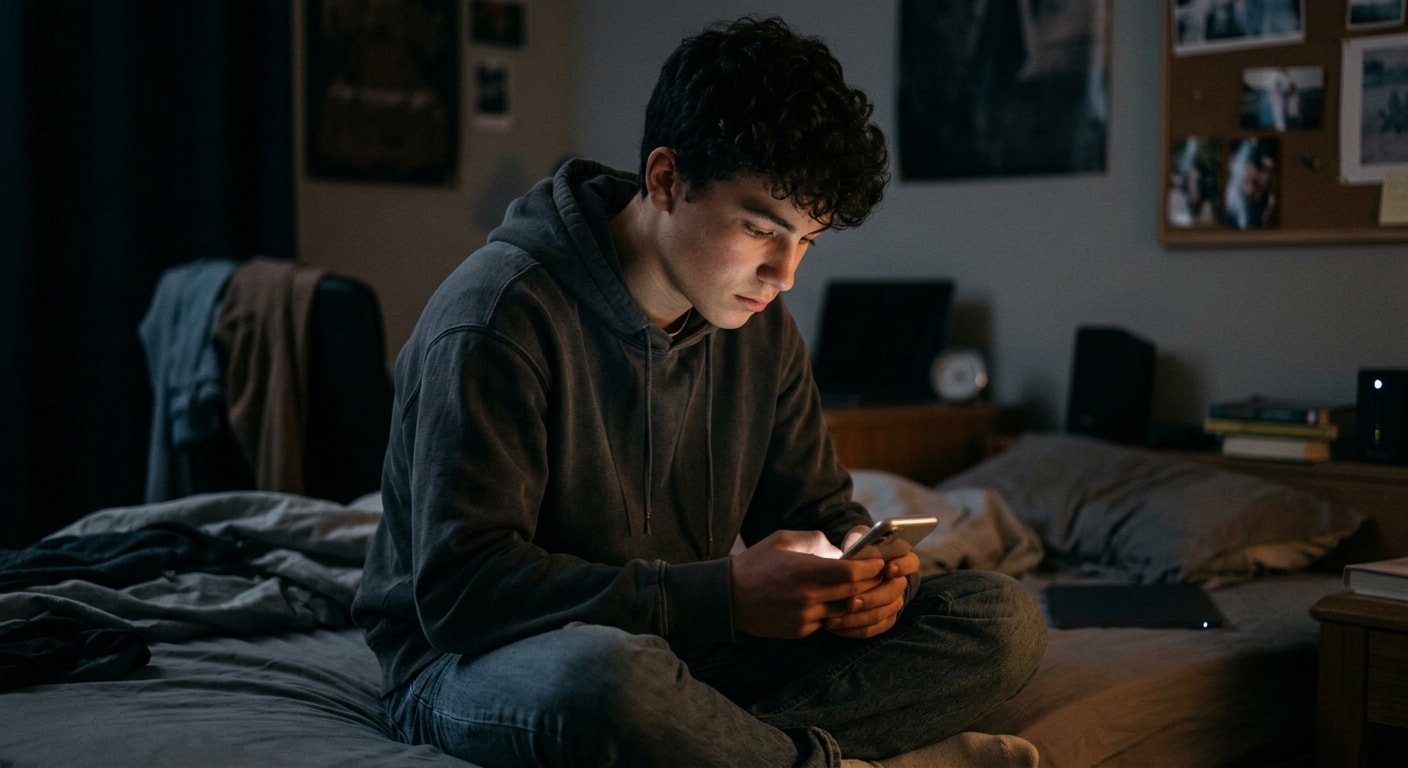
Your teen picks up their phone to check one thing. Twenty minutes later they put it down a little quieter, a little flatter, a little less sure of themselves than they were before. They probably could not tell you exactly what happened. What happened is the comparison trap, and it is one of the most powerful and least visible forces shaping how young people feel about themselves today.
Teenagers have always compared themselves to others. That is not new. What is new is the scale, the speed, and the ruthlessness of it. A generation ago, a teen compared themselves to the thirty kids in their class. Today they compare themselves, hundreds of times a day, to a curated global highlight reel of the best moments of everyone they have ever met plus thousands of strangers and influencers who do this for a living. The brain was never built for that. Here is how the trap works, what it is doing to teen self-worth, and how to help your child climb out of it.
To understand the damage, start with the stage. Adolescence is the period when identity gets built. Teens are actively working out who they are, where they fit, and whether they measure up. To do that, the developing brain pays enormous attention to peers and to social standing. Fitting in and being valued by the group feels, at this age, like survival.
That makes teenagers uniquely vulnerable to comparison. An adult scrolling past a friend’s vacation photos might feel a small pang and move on. A teen whose sense of self is still forming can take the same image as evidence about their own worth. Everyone else is happier, prettier, more popular, more successful. The comparison is not a passing thought. It becomes a verdict.
Now consider how much of this they are exposed to. A Pew Research Center report found that nearly half of US teens, 46 percent, say they are online almost constantly, roughly double the share a decade earlier. Platforms like YouTube, TikTok, Instagram, and Snapchat are where teens live socially, and each one runs on images of other people’s best, most polished, most filtered moments. The exposure is not occasional. For many teens it is close to nonstop.
The core cruelty of the comparison trap is that it is rigged. Teens are comparing their messy, ordinary, behind-the-scenes real life against everyone else’s edited highlight reel. They see the party they were not invited to, the friend group that looks perfect, the body that looks flawless after filters and good lighting and fifty deleted attempts. They do not see the insecurity, the boredom, the arguments, the ordinary Tuesday behind the post.
So the comparison is never fair, and the teen almost always loses, because real life cannot compete with a curated feed. Over time this does something corrosive. It teaches a young person that their normal, unedited existence is somehow not enough. Researchers studying social comparison and self-esteem have repeatedly found links between heavy social comparison online and lower self-worth, more anxiety, and more depressive feelings, especially among adolescent girls.
The data on girls is particularly stark. The CDC’s 2023 Youth Risk Behavior Survey found that nearly 53 percent of teen girls reported persistent feelings of sadness or hopelessness, far higher than boys. There are many reasons for that gap, but the appearance-focused, comparison-heavy nature of the platforms girls use most is widely considered part of the picture.
Comparison is only half the trap. The other half is validation. Social platforms are engineered around likes, comments, views, and follows, which turn self-worth into a public scoreboard. For a teenager whose identity is still under construction, that scoreboard becomes dangerously important.
Here is the loop. A teen posts something and waits. The likes come in, and for a moment they feel good, seen, validated. Then the feeling fades, and they need to post again to get it back. If a post underperforms, it does not feel neutral. It feels like rejection, like proof they do not matter. The brain’s reward system, already extra sensitive in adolescence, gets hooked on the hit of approval and the fear of its absence.
This is not a character flaw in your teen. It is the designed outcome of products built to maximize engagement. The platforms profit when young people keep checking, keep posting, and keep seeking the next hit of validation. Your teen is up against billion-dollar engineering aimed squarely at the most vulnerable part of their developing brain.
The US Surgeon General took this seriously enough to issue a formal advisory in 2023 warning about social media and youth mental health. It noted that adolescents who spend more than three hours a day on social media face a heightened risk of anxiety and depression symptoms, and many teens far exceed three hours. The warning was not that social media is pure poison. It was that we have handed young people a powerful tool whose risks we are only beginning to manage.
The comparison trap is mostly invisible because it happens inside. But it leaves tracks. Watch for a mood that drops specifically after phone use, harsh self-criticism about looks or popularity, obsessive checking of how a post is performing, distress over being left out of something seen online, or a growing belief that everyone else’s life is better than theirs. Comments like “I’m so ugly,” “nobody likes me,” or “everyone’s having more fun than me” are often the comparison trap talking, not a sober assessment of reality.
You cannot unplug your teen from their generation’s social world, and trying to ban it outright usually backfires. What you can do is weaken the trap’s grip and build your teen’s resistance to it.
The comparison trap is not going away, and your teen will be navigating some version of it for the rest of their life. The goal is not to shield them from it forever. It is to help them see it clearly, feel its pull without being ruled by it, and build a sense of worth solid enough to withstand the endless scroll. That work starts at home, with a parent willing to talk about it honestly rather than just taking the phone away.
What is the comparison trap?
The comparison trap is the cycle of measuring yourself against other people’s curated online images and coming up short. Teens compare their real, unedited lives to everyone else’s highlight reels, which is never a fair comparison and steadily erodes self-worth.
Why does social media affect teen self-esteem so much?
Adolescence is when identity and self-worth are forming, so the brain pays intense attention to peers and social standing. That makes teens especially vulnerable to comparison and to the likes-and-validation scoreboard that social platforms are built around.
Is social media really linked to teen anxiety and depression?
Research links heavy social comparison online with lower self-esteem and more anxiety and depressive symptoms, especially in girls. The US Surgeon General’s 2023 advisory warned that teens spending more than three hours a day on social media face a heightened risk of anxiety and depression symptoms.
Should I just take my teen’s phone away?
Outright bans usually backfire and cut off your insight into their world. A more effective approach is to explain how the trap works, build phone-free times and zones as a family, and help your teen develop sources of self-worth that do not depend on likes.
How can I tell if my teen is struggling with online comparison?
Watch for a mood that drops after phone use, harsh self-criticism about looks or popularity, obsessive checking of how posts perform, and distress over being left out of things seen online. Comments like “everyone’s life is better than mine” are often the comparison trap talking.
What is the best protection against the comparison trap?
A sense of self that lives offline. Teens who invest in creating, hobbies, relationships, and skills that give real internal satisfaction are far less dependent on the validation scoreboard and more resilient to comparison.