
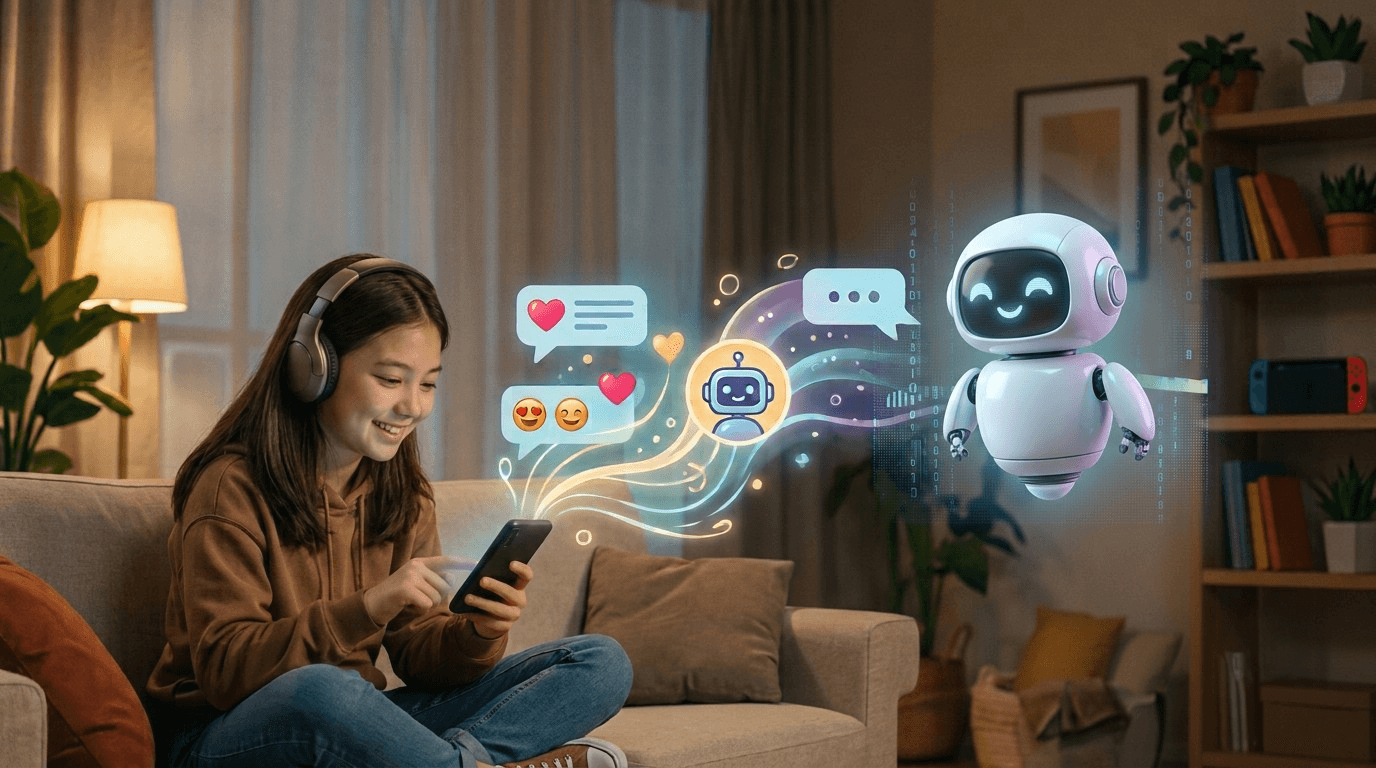
There is a good chance that, right now, your teenager has a friend you have never met and never will, because that friend is not a person. It is an AI. Not a homework helper or a search tool, but a chatbot built to act like a companion: to chat, to listen, to flirt, to comfort, to always be there. Millions of teens are already talking to these AI companions every day, and most parents have no idea it is happening.
This is one of the fastest-moving and least understood shifts in teen life, and it has arrived almost overnight. AI companions are not science fiction and not a fringe curiosity. They are mainstream among today’s teenagers, and they raise real questions about emotional development, safety, and what friendship even means. Here is what AI companions are, what the research is already showing, and how to talk to your teen about them without panic or dismissal.
An AI companion is different from a tool like a search assistant. It is a chatbot designed specifically to simulate a relationship. Apps such as Character.AI, Replika, and others let users talk to AI characters that remember past conversations, have personalities, express what looks like care and emotion, and are available every hour of every day. Some are set up as friends, some as mentors, some as romantic or even flirtatious partners.
For a teenager, the appeal is not hard to understand. An AI companion never judges, never gets bored, never has its own bad day, and never turns the conversation back to itself. It is endlessly patient and always available at 2 am when a teen feels alone. For a young person who is shy, anxious, lonely, or struggling socially, a companion that offers constant, pressure-free attention can feel like a relief. That is exactly what makes this worth paying attention to, in both directions.
If your instinct is that this is a niche thing for a few isolated kids, the data says otherwise. A nationally representative survey of more than a thousand US teens aged 13 to 17, conducted by Common Sense Media in 2025, found that 72 percent of teens had used an AI companion at least once. More than half said they use these companions regularly, at least a few times a month. This is not a small subculture. It is most of a generation.
The same study found some reassuring things and some concerning ones, and parents deserve the full picture rather than only the scary headlines. On the reassuring side, 80 percent of teens who use AI companions said they still spend more time with real friends than with the AI, and half said they simply do not trust the information or advice the companions give them. Many teens, it turns out, are using these tools with a degree of skepticism and are not abandoning human relationships for them.
On the concerning side, the picture is genuinely worrying in places. About a third of teen users said they had used AI companions for serious conversations, including emotional support, instead of talking to a real person. Around a third reported feeling uncomfortable with something a companion had said or done. And roughly a quarter said they had shared personal information, including their real name, location, or private secrets, with an AI companion. Common Sense Media, the organization behind the study, concluded that these companions can pose real and in some cases unacceptable risks to young users, and recommended that minors not use them.
The risks here are not the obvious ones most parents first imagine. They are subtler and worth understanding clearly.
The first is emotional over-reliance during the exact years when social skills are supposed to be built. Adolescence is when young people learn the hard, awkward, essential skills of real relationships: handling conflict, reading other people, tolerating rejection, repairing a friendship after a fight. A real friend pushes back, misunderstands you, and has needs of their own, and learning to navigate all of that is how a person grows. An AI companion removes the friction. If a teen increasingly turns to a frictionless AI instead of messy human relationships, they may miss crucial practice at the very time they most need it.
The second is the quality and safety of what these companions actually say. Because they are built to be agreeable and engaging, AI companions can validate a teen’s feelings uncritically, including unhealthy ones, rather than gently challenging them the way a caring human might. They can also behave in ways their makers did not fully intend. There have been serious and highly publicized cases. Lawsuits have been filed against Character.AI, including one in Florida connected to the death of a 14-year-old, alleging that interactions with a companion contributed to a tragic outcome. These cases are still working through the courts, but they have put a spotlight on how little safety testing these products received before reaching young users.
The third is privacy. As the survey showed, a sizable share of teens are sharing genuinely personal information with these apps. That data goes to a company, and teens rarely stop to consider where it ends up or how it might be used. A companion that feels like a trusted friend can coax out disclosures a teen would never post publicly.
The worst responses here are the two extremes: panicking and banning everything, or dismissing it as harmless kid stuff. Both shut down the conversation you actually need to have. Here is a more useful approach.
It is worth drawing a clear line, because parents hear “AI” and lump very different things together. Your teen using an AI assistant to explain a math concept, brainstorm an essay, or summarize an article is using AI as a tool. The relationship is transactional. They ask, it answers, they move on. That kind of use raises its own questions about learning and honesty, but it is a fundamentally different activity from what AI companions offer.
An AI companion is built to simulate a relationship, not to complete a task. It is designed to feel like someone who knows you, cares about you, remembers your history, and is emotionally invested in you. The pull is not “this helped me finish my homework” but “this feels like a friend who is always there.” Some popular apps blur the line, offering both helpful assistants and relationship-style characters in the same place, which is part of why the companion side can slip past parents who think their teen is just using AI for school. When you talk with your teen about this, name the distinction. Using AI to learn something is one conversation. Leaning on AI for friendship, comfort, or emotional support is a different one, and it is the second that warrants closer attention.
Some parents reading this will realize their teen is not just dabbling but genuinely relying on an AI companion, perhaps as a main confidant. If so, the worst move is to react with shock, ridicule, or an abrupt ban, all of which usually drive the behavior underground and damage trust. A teen who has formed an emotional attachment to a companion did so because it was meeting a real need, and shaming them for it only confirms the loneliness that drew them in.
Start from curiosity and warmth. Ask what the companion gives them that they are not getting elsewhere. The answer, whether it is someone to talk to at night, a space without judgment, or relief from social anxiety, is the real problem to solve. Gently and consistently work to meet that need through human connection: more one-on-one time with you, support in building or repairing friendships, a creative or community outlet where they feel seen, and where appropriate, a counselor who can help. Set limits on the companion use, but pair every limit with an increase in real connection, so you are not just taking something away but offering something better in its place. If the attachment is intense, if your teen is withdrawing from real life, or if the interactions seem to be feeding distress, bring in a mental health professional. This is new enough territory that there is no shame in asking for expert help, and acting early matters.
AI companions are not going away, and your teenager is growing up in the first generation to navigate them. Some use will be harmless, even helpful in small doses. But these are powerful, under-regulated products aimed at an emotionally vulnerable age group, and the early evidence is a clear call for parents to pay attention rather than look away.
You do not need to become a technology expert to handle this well. You need to stay curious, stay connected, and keep the conversation open. The most effective thing you can offer your teen is not a better chatbot or a total ban. It is the real human connection that no AI can replace, and the steady message that when they need someone to talk to, a real person is here. In a world where machines are learning to imitate friendship, that genuine presence matters more than ever.
What is an AI companion?
An AI companion is a chatbot designed to simulate a relationship rather than just answer questions. Apps like Character.AI and Replika offer AI characters that remember past chats, have personalities, express apparent emotion, and are available at all hours as friends, mentors, or even romantic partners.
How many teens actually use AI companions?
A 2025 nationally representative survey by Common Sense Media found that 72 percent of US teens aged 13 to 17 had used an AI companion, and more than half use them regularly. This is now mainstream among teenagers, not a niche activity.
Are AI companions safe for teens?
They carry real risks. Common Sense Media concluded that AI companions can pose unacceptable risks to minors and recommended that young people not use them. Concerns include emotional over-reliance, uncritical or unsafe responses, privacy loss, and serious publicized safety cases, including lawsuits against Character.AI.
Why would my teen talk to an AI instead of real friends?
AI companions never judge, never get bored, and are always available, which can feel like a relief for a teen who is shy, anxious, or lonely. If your teen leans on one for support, it often signals an underlying need for connection that is worth addressing with real relationships.
Should I ban my teen from using AI companions?
Banning without conversation tends to backfire and cut off your insight. A more effective approach is to get curious about why they use it, explain what these products really are, set clear privacy limits, and strengthen real human connection. For younger teens especially, strongly discouraging use is reasonable given the known risks.
What warning signs should I watch for?
Be concerned if your teen withdraws from real friends in favor of an AI, seems distressed after interactions, is secretive about their use, or relies on a companion as their main emotional support. Any of these warrants a gentle conversation and, if needed, professional help.