
Psychosocial problems affect 10% to 20% of children and adolescents worldwide. Many of these young ones struggle to put their feelings into words. Parents search for alternative ways to understand their inner worlds.
Learning how to help kids express emotions through art offers a powerful solution. Expressive arts positively affect function, mood, cognition and behavior. Children get a safe outlet to process experiences and develop coping skills. Parents can support their child's emotional regulation without requiring verbal communication with art therapy activities for kids and feelings art projects.
This piece walks parents through creating an art practice at home that nurtures emotional well-being.
Children often feel emotions more intensely than adults, yet they lack the vocabulary to express themselves. Emotional development happens long before language catches up. Young children, and even older kids, feel emotions in their bodies first through tight shoulders, restless energy, stomach aches, or sudden frustration before they can name what they're experiencing. Art therapy for anxiety in children bridges this gap between feeling and speaking.
Visual art conveys emotion through color, shape, spacing, and motion without requiring words. Red may feel loud or urgent. Blue often suggests calm or sadness. Sharp geometric shapes might suggest tension or conflict, while smooth, rounded forms feel safe and welcoming. A child might draw a stormy picture when feeling angry or use bright colors when excited. These visual cues give parents insight into a child's internal world without requiring the child to explain everything.
The language of visual art (colors, shapes, lines, and images) speaks in ways that words cannot. Anger might appear as sharp lines or dark colors. Joy may show up as bright patterns. Sadness might look quiet or empty. Art therapy is an experiential form of treatment that has a special position in the treatment of children and adolescents because it is an available and non-threatening form of treatment.
Creative expression removes the pressure of finding the right words. Words can feel exposing for children and bring a fear of saying the wrong thing, being misunderstood, or disappointing adults. Drawing feelings activity for kids eliminates that risk. Art making consists of creation, observation, reflecting, and meaning-making, which guides to change and insight.
Creative activities such as drawing, painting, or sculpting promote relaxation, reduce stress, and regulate emotions. The rhythmic actions of painting or molding clay calm the mind and lower anxiety. They help children focus on the present moment. Coloring can be a calming and therapeutic activity, especially for emotion regulation. Art activities help children come down from heightened emotional states when they feel overwhelmed or dysregulated. They develop coping strategies to manage their emotions.
Creating something tangible gives children a sense of accomplishment and boosts self-esteem. A piece of art provides a sense of pride and reinforces the idea that their feelings and ideas are valid and worthy of expression. Creative art activities provide children with opportunities to build their confidence, problem solve, and explore their creativity. They also help children explore social-emotional skills.
Art therapy offers distinct advantages across developmental stages. Drawing helps young children with limited verbalization skills express emotions when words aren't yet there. Visual image-making is an important aspect of the natural learning process. Children, in the presence of an adult, can get in touch with feelings that otherwise cannot be expressed in words.
Preschool and early elementary children benefit from feelings art projects that teach them to identify and label emotions. Parents can ask questions that support emotional vocabulary building once a child finishes a piece of art. The more words children have for emotions (frustrated, excited, nervous, proud), the easier it becomes to understand and communicate their feelings.
School-aged children who express themselves creatively become more emotionally intelligent. Children learn about their thoughts and feelings and develop coping skills through artistic expression. They learn to recognize emotions earlier, tolerate frustration longer, and recover from emotional upset more smoothly. They develop coping strategies.
Art therapy gives children resilience to guide through challenges and adversity. Children learn to problem-solve, regulate emotions, and develop adaptive coping strategies through art-making. Knowing how to express themselves and practice skills gives a sense of control and self-efficacy. It promotes self-discovery.
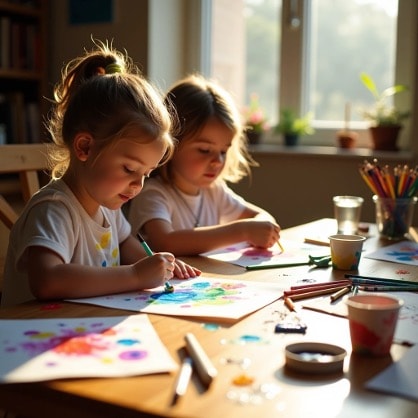
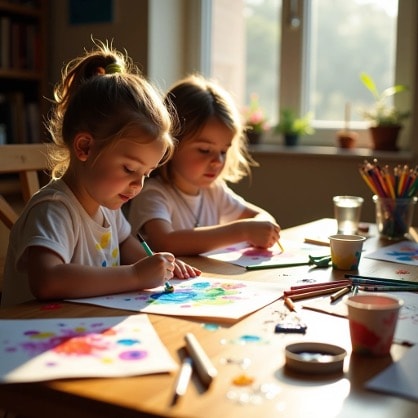
You need a dedicated space for art therapy activities with kids. Start by picking the right spot. Children should reach the area on their own without moving furniture or asking for help. A corner of the living room works well. So does a section of the dining table or a spot in the playroom.
Natural light improves color perception and creates an inviting atmosphere. Windows provide the best lighting conditions for creative work. If natural light is limited, adequate artificial lighting keeps eyes from straining during detailed activities. Proximity to supply storage also helps the creative process. When materials sit within arm's reach, children stay focused rather than interrupt their work to search for items.
Safety considerations guide where you choose the location. Avoid areas with sharp corners, unstable furniture, or limited movement space. The flooring underneath the art space should tolerate potential spills and stains. Vinyl, tile, or laminate floors clean more than carpet does. You can place protective mats or silicone baking sheets beneath the workspace to safeguard surfaces without expensive investments.
Noise levels affect different children in distinct ways. Some thrive with background activity. Others need quiet to concentrate. Visibility from common areas lets you supervise without hovering and signals that creative time holds value within family life. Flexibility makes sure the space adapts as interests evolve. A portable rolling cart transforms any location into an instant art station and tucks away when not needed.
Start with affordable supplies to keep things manageable. Finger paints and thicker crayons work well for toddlers around 1 to 3 years old. Grade school children around 5 years and above handle more precise tools. Test various cheaper craft supplies first and let children find their priorities before you invest in expensive sets.
A starter collection for expressing emotions through art has:
· Construction paper or butcher paper rolls (sturdy, tear-resistant)
· Crayons and washable markers
· Watercolor paints and brushes
· Glue sticks and liquid glue
· Safety scissors with blunt tips
· Play-doh or modeling clay
· Colored pencils
Quality matters more than quantity. Durable crayons break less when dropped and require less frequent sharpening. Construction paper provides a sturdy surface that resists tearing and prevents bleed-through. Washable products protect clothing and furniture from permanent damage.
Storage solutions keep materials organized and available. Clear containers let children see contents without digging through boxes. Open storage encourages independence. Children locate items and return them to designated spots. Labels with words or pictures help younger children identify where materials belong. Tall clear cylinders around 6 inches high work well for markers and colored pencils. They prevent spills while maintaining visibility.
A safe and encouraging environment is essential to help kids express big emotions. Children need freedom to explore without criticism. Praise efforts rather than results. Instead of commenting on whether artwork looks "beautiful" or "correct," ask what they thought about while creating it.
Focus on the process, not the product. Art for emotional regulation requires experimentation, mistakes, and messy exploration. Never finish a child's work or correct their color choices. The creative space becomes a haven where feelings flow and expression takes any form necessary.
Parents can start with a simple feelings drawing activity for kids. Children check in with themselves before they draw by noticing what emotion surfaces. Ask them to close their eyes and imagine what color, shape, form, or texture matches that feeling. They then depict this on paper using colors, shapes, and lines. The process requires no visualization skills; children trust their intuition about what feels right. A title and date help track emotional patterns over time.
Abstract emotion paintings bypass the need for recognizable images. Children select colors they connect with specific feelings and explore what lines, shapes, and gestures could express those emotions. Quick work prevents overthinking and keeps the process spontaneous. Parents might play different pieces of music while children paint three separate emotion paintings and compare how colors and styles differ across emotional states.
Worry dolls originated in Guatemala. Children there share concerns with tiny handmade dolls and place them under pillows overnight. Parents can help children make their own using pipe cleaners bent into figure shapes and wrapped with colorful wool. Younger children can cross two lolly sticks and secure them with elastic bands to create a simpler base before binding with wool. Older children might collect Y-shaped twigs, layer two together to form a body, and dress the figure with fabric scraps. Children whisper worries to their dolls after creation and externalize anxious thoughts into tangible objects.
Collage activities suit children struggling with layered emotions. They collect papers with varied textures and colors from magazines, junk mail, or painted sheets. Children select three favorite papers, reflect on what emotions the colors and textures evoke, and choose additional papers matching their main feeling. Torn edges rather than cut ones add emotional expression. Children can layer pieces without gluing first and experiment before committing to the final design.
Clay provides a kinesthetic outlet to release tension. Children shape an angry object or animal from air-dry clay and describe what this creation protects or fears. The physical manipulation of clay stimulates energy release through movement and makes it effective for anger management.
Music paired with visual art deepens emotional expression. Children draw one continuous line while they listen to a song and adjust their marks as the music shifts in volume or tempo. Fast music might produce jagged, quick strokes while slow melodies create gentle curves.
No content was provided in the user_text tag. Please provide the text you would like me to humanize and rewrite.
Turning occasional creative sessions into sustained emotional support requires intentional scheduling. Consistency matters more than session length. A 10-minute daily art journal or a weekly creative session can have meaningful benefits. Short, frequent participation builds stronger habits than sporadic lengthy sessions that feel overwhelming or difficult to maintain.
Habit stacking links art time to an existing routine and makes the practice sustainable. Parents might place art supplies beside the breakfast table and invite children to draw while waiting for morning routines. Creative time after homework completion or before bedtime rituals creates natural transitions as an alternative. The key involves attaching the new behavior to an established pattern rather than relying on motivation alone.
Research demonstrates that even just 15 minutes of art every day can be a habit that pays long-term dividends. Regular practice improves observational skills and adaptability, which connects to state-of-the-art thinking and personal well-being. More important is that participating in arts activities over many months increases positive emotions and lowers stress as measured by cortisol levels.
Treating creative time as an actual appointment signals its importance. Parents might designate Tuesday and Thursday evenings as "art nights" or Sunday mornings as "feelings drawing time." Visible calendars or reminder notes reinforce commitment without creating pressure. The goal centers on predictability rather than perfection.
Regular practice fosters emotional resilience over time. Children repeatedly externalize and examine feelings through art. They develop a stronger capacity to recognize, understand and cope with difficult emotions. The beauty of combining creative expression with consistent practice means children walk away with more than just insights. They develop available, tailored tools for daily life.
Developmental changes require corresponding adjustments to art therapy activities for kids. Toddlers thrive with sensory-rich experiences like finger painting and playdough, which provide tactile exploration. Preschoolers begin combining shapes and colors with intention. This makes emotion wheels and feelings charts appropriate. Early elementary students handle more complex projects such as collage work and sequential storytelling through comics.
Middle childhood brings increased interest in realism and technical skill. Children at this stage benefit from activities combining structure with emotional depth, such as creating mandalas during anxious moments or sketching worry maps that organize concerns in a visual way. Tweens and teenagers often prefer private creative journals where they control who sees their work.
Sensory priorities change as children mature. Young children might prefer large movements with thick brushes. Older children gravitate toward detailed work with fine-tipped markers. Some children always prefer three-dimensional materials like clay. Others favor two-dimensional drawing. Parents can observe these patterns and offer materials matching developmental comfort zones while introducing new options with care.
Home-based art for emotional regulation serves many children well. Yet certain situations call for credentialed expertise. Art therapy is a mental health profession in which a credentialed art therapist uses art-making within a therapeutic relationship to support children's physical, emotional and social well-being. Professional sessions include art-making and reflective conversation that connects what a child created to what they're feeling and experiencing.
Children who struggle to express feelings, experience persistent anxiety, show signs of depression, or have trauma histories often benefit from professional support. Art therapy addresses these challenges through structured interventions that parents cannot replicate without specialized training. To cite an instance, art therapy can help children experiencing difficulty expressing feelings by providing a creative outlet for complex emotions they can't verbalize.
Art therapy proves effective for anxiety. It helps children externalize worries, manage panic symptoms and develop calming techniques through creative expression. Art provides a pathway to express heavy feelings of sadness for those experiencing depression. It helps them refind motivation and rebuild a sense of self-worth when words feel too heavy. The practice also supports individuals navigating eating disorders by addressing body image concerns and self-perception in a gentle, exploratory way.
Children adjusting to new diagnoses, long hospital stays, or frequent medical appointments could benefit from greater autonomy and consistent coping tools. Patients with neurodivergence, developmental differences, or those who resist traditional talk therapy may thrive with sensory-based and symbolic expression in a similar way.
Professional art therapists understand how different materials and creative activities support specific therapeutic goals through frameworks like the Expressive Therapies Continuum. This specialized knowledge ensures activities match what a child needs in that moment, whether grounding, coping skills development, or working through complex feelings.
Parents need not wait for a formal diagnosis to seek support. Art therapy offers a proactive, supportive approach to emotional development if instinct suggests a child is struggling.
Parents now have everything needed to support their child's emotional well-being through creative expression. Note that consistency matters more than perfection. Start with simple supplies, create a judgment-free space, and make art time a regular part of family routines.
Children who express feelings through colors, shapes and textures develop stronger emotional intelligence and coping strategies. Results won't appear overnight. With patience and practice, parents will notice their children recognizing emotions earlier, recovering from upsets more smoothly and communicating inner experiences with greater confidence.
Keep the process playful and focused on expression rather than artistic skill. Emotional resilience builds one creative session at a time.