
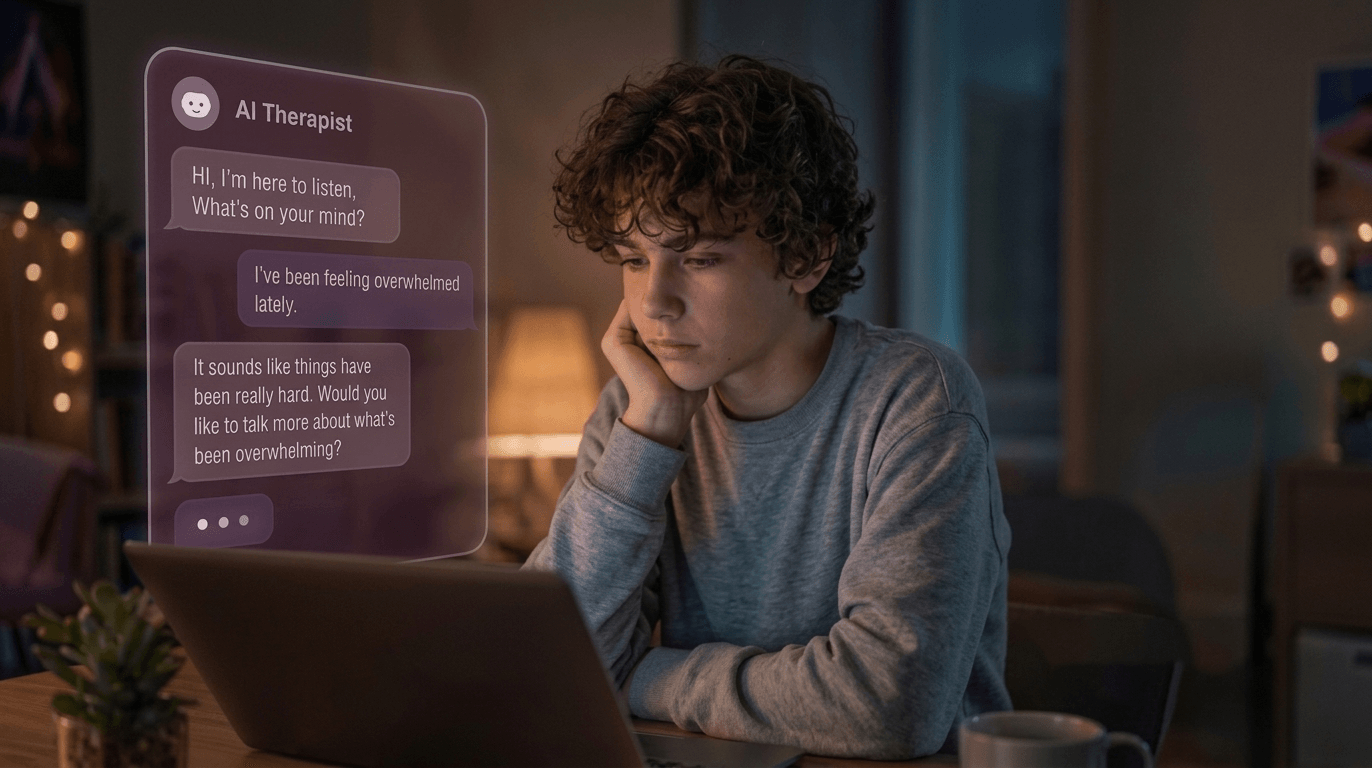
If you have ever opened an app at midnight because your brain would not stop spinning, you have probably wondered: can AI actually help with anxiety, or is it just something to type at? It is a fair question, and the honest answer sits in the middle. AI tools can do a few genuinely useful things when you are stressed. They also have real limits that matter a lot, especially on your worst days. This guide breaks down what AI for anxiety can and cannot do, so you can use it without expecting it to be something it is not.
Used the right way, an AI tool can take the edge off in the moment. It is available instantly, it does not judge you, and sometimes that is enough to get unstuck. Here is where it genuinely helps.
Anxiety is often a blur. You know you feel bad but cannot say why. Typing it out, even to an AI, forces the fog into sentences, and naming a feeling tends to shrink it a little. That is a real, documented effect, and it does not require the listener to be human.
When your heart is racing, remembering what to do is hard. An AI can talk you through slow breathing, a grounding exercise, or a quick body scan, step by step, at 2 a.m. when no one else is awake. It is basically an on-call coach for skills you already have but cannot think of under stress.
Dreading a conversation, a text, or asking a teacher for help? You can practice on an AI first, get the words out, and take some of the fear out of doing it for real. Think of it as a batting cage, not the actual game.
Here is the part the app store descriptions skip. AI has hard limits, and knowing them protects you.
If you want AI in your toolkit, use it as one tool, not the whole toolbox. A few ground rules keep it healthy.
Better tools than an app, most of the time
AI can be a helpful bridge, but the things that reliably lower anxiety over time are mostly low-tech. Moving your body, sleeping enough, getting outside, and talking to someone who knows you all outperform any chatbot. So does creative expression: writing, drawing, music, and journaling give anxious energy somewhere to go and help you process what you feel. If your school has a counselor, that is a free, trained, human resource built for exactly this. An app can nudge you toward these. It cannot replace them.
AI is fine for everyday stress. It is not enough when anxiety starts running your life. Reach out to a trusted adult, a school counselor, or a doctor if worry is stopping you from sleeping, eating, going to school, or seeing friends, if it has lasted for weeks, or if it ever tips into thoughts of self-harm. That last one is not something to sit with alone or type into an app. In the US you can call or text 988 any time and a real person will answer.
This article is for informational purposes only and is not a substitute for professional medical or mental-health advice. Voices Under One Sun is a peer-support and self-expression community, not a treatment provider.
Can AI actually help with anxiety?
In small ways, yes. AI can help you name what you are feeling, walk you through a calming exercise, and rehearse something stressful before you do it. It is not therapy and cannot know you or help in a crisis, so it works best as one tool alongside real people and real coping skills.
Is it okay to use an AI chatbot when I am stressed at night?
For everyday stress, it can be a fine way to get your thoughts out and calm down. Just keep it as a first step, not your only support, and never rely on it for anything involving self-harm or feeling unsafe. For those moments, reach a trusted person or text 988.
What is the difference between an AI app and real therapy?
A therapist is a trained human who gets to know you over time, notices patterns, challenges unhelpful thinking, and is responsible for your safety. An AI app responds only to what you type in the moment, tends to agree with you, and has no accountability. One supports the other at best; it does not replace it.
Are AI mental health apps safe for teens to use?
They can be reasonably safe for light, everyday use if you protect your privacy and do not lean on them during a crisis. Assume what you type may be stored, avoid sharing anything deeply private, and keep trusted people involved so the app supports your real relationships instead of replacing them.
Why does talking to an AI feel easier than talking to people?
Because it is instant, never judges, and never seems annoyed. That feels great when you are anxious, but it is partly because the app agrees with almost anything and cannot truly care. Easier is not the same as better, and real people are the ones who can actually follow up and help.
What should I do instead of using AI when anxiety gets really bad?
When anxiety is running your life, go to a trusted adult, a school counselor, or a doctor. Everyday tools like moving your body, sleeping, getting outside, and creative expression help more over time than any app. And for anything involving self-harm, call or text 988 right away.