
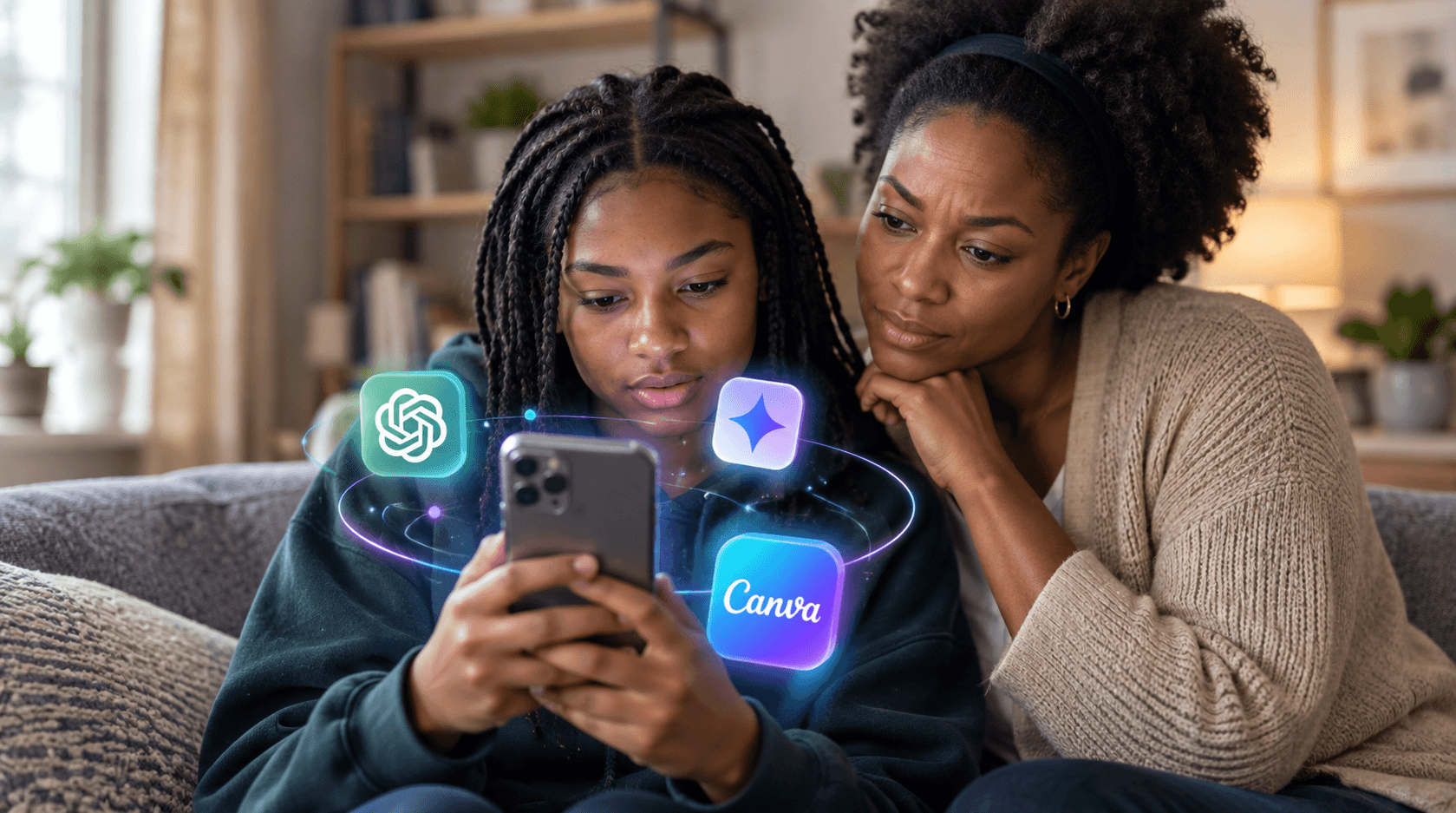
AI companion apps have moved quickly from novelty to everyday use among teenagers. These are tools that let a user chat with an AI character that responds in a warm, human-sounding, emotionally engaged way. Many parents first hear about them when they notice one on a phone, and the question that follows is a fair one: are these apps safe for a teen to use?
There is no single yes or no. The honest answer is that it depends on how an app is used, what a teen brings to it, and whether an adult knows it is happening at all. This guide lays out the real risks and what a parent can do about them, without the panic.
An AI companion is software designed to hold an ongoing, personal-feeling conversation. Some are marketed openly as virtual friends or partners. Others are general-purpose assistants that a teen simply starts confiding in. What they share is a design goal: to be engaging enough that the user keeps coming back. That goal is worth keeping in mind, because it is not the same as a goal of keeping a young person safe or well.
Understanding the appeal makes the risks easier to talk about. For a teen, an AI companion is always available, never tired, and never judgmental. It does not get bored of the same worry repeated three nights running. For a young person who feels like too much for the people around them, or who struggles to open up face to face, that combination is powerful. Surveys of teens suggest a meaningful share have used these tools for comfort or advice, and that many did so without telling a parent.
It tends to agree rather than challenge. A good friend or adult will sometimes push back, correct a distorted thought, or say plainly that it is time to talk to someone. An app built to keep a conversation pleasant and ongoing has little reason to do that. Clinicians and researchers have raised concern that some companion apps stay inside a user's mood rather than steering a struggling teen toward help.
It can quietly replace people. Because the app is the easiest place to be heard, it can start to crowd out the harder, more valuable work of being known by real friends and family. That substitution rarely announces itself. It just slowly becomes the default.
It happens out of sight. These conversations are private by nature. Whatever a teen is working through can play out entirely outside any adult's awareness, which means no one is positioned to notice if things are getting worse.
It is not equipped for a crisis. An app cannot reliably recognize when a teen is in real danger, cannot read tone or behavior over time, and cannot decide to involve a trusted person. For a safety situation, that is a serious limitation.
They help, and they are not enough on their own. Device-level tools and app settings can limit access and give a parent some visibility, and they are worth using. But age checks and restricted modes can be worked around by a motivated, tech-fluent teen, and settings change often. Controls are best thought of as a seatbelt: useful, sensible, and not a replacement for paying attention.
1.Know what is on the phone. Look for apps described as an AI friend, companion, or character chat, and check the browser too, since many run without an install.
2.Use device-level controls. Built-in screen-time and family tools give broader oversight than any single app's own settings.
3.Lead with curiosity, not confiscation. Asking what an app is like, and what a teen gets from it, opens more doors than an interrogation.
4.Address the need underneath. A teen reaching for an app for comfort is usually signaling loneliness, stress, or not feeling heard. The app is the symptom, not the cause.
5.Point clearly toward people. Make sure a teen knows where the humans are: a parent, a school counselor, a trusted adult, and 988 for anything urgent.
It is worth reaching out to a mental-health professional or a teen's doctor if a parent notices any of the following:
● Distress, anger, or panic when the app or device is unavailable.
● Describing the app as a best friend, or preferring it to real people.
● Withdrawal from friends, family, or activities they used to enjoy.
● Any talk of hopelessness or self-harm. This is not a wait-and-see situation; reach 988.
Restricting one app does not resolve the reason a teen reaches for a machine instead of a person late at night. That reason is usually some form of feeling alone. The most protective thing a family can build is not a longer blocklist but a set of relationships in which a teen feels seen enough that an app does not have to fill the gap. That is slower work than changing a setting, and it is the only thing that genuinely competes with an always-available AI companion.
This article is for informational purposes and is not a substitute for professional medical or mental-health advice. Voices Under One Sun is a peer-support and self-expression community, not a treatment provider.
Are AI companion apps safe for teens?
It depends on how they are used. Occasional, open use can be low-risk, while daily secret use, or leaning on an app during real distress, raises real concerns. The safest situation is one where a parent is aware and the app is not a teen's main source of support.
Why do teens use AI companion apps?
They are always available, patient, private, and non-judgmental. For a teen who feels unheard or struggles to open up in person, that combination is very appealing, which is why many use them without mentioning it to anyone.
Can parental controls keep my teen safe on these apps?
They help but are not foolproof. Device and app controls provide useful limits and visibility, yet tech-savvy teens can often work around them. Treat controls as one layer alongside conversation and attention, not a complete solution.
Should I ban my teen from using AI companion apps?
A flat ban often pushes use out of sight, removing a parent's visibility and influence. For many families, clear boundaries and open conversation work better, with one firm exception: anything involving a crisis should always go to a trusted person or 988.
How do I know if my teen relies on an app too much?
Watch the role it plays, not just the hours. Warning signs include secrecy, distress when it is unavailable, calling it a best friend, and withdrawing from real relationships to spend time with it.
What should a teen never use an AI companion app for?
Anything involving self-harm, suicidal thoughts, abuse, or an urgent crisis. An app cannot keep a teen safe in those moments. Those always belong with a trusted adult, a counselor, or 988.